
 Engineer
Early access iPhone, iPad and the web. Sign in on the web


ENGINEER
Accountability. Clarity. Results.
Every date is a promise. Every delay is traced to where it started.
Vector Engineer runs stage-gate projects from the bottom up. Each deliverable has one owner who agreed to the date, the work it's waiting on, and sign-offs that lock exactly what was checked. When something slips, everyone downstream sees why, and who owns the delay.
- The common six-gate stage-gate, or your own
- Owners accept dates; nobody is handed one
- Every review finding fixed, signed off, or carried on the record
- Lessons learned write themselves
The problem
A Gantt chart can show a project is late.
It can't tell you why.
Dates handed down
The plan is built top-down, so the people doing the work never agreed to it. Everyone knows the dates are fiction; nobody says so.
Blame rolls downhill
A late casting makes the build late, the test late and the launch late. By the gate review, the last person in the chain looks like the problem.
"Signed off" on what?
The drawing changed after the review. Which version did the checker actually look at? Nobody can say, and the defect shows up in production.
How it works
One handshake, for every deliverable
Every drawing, analysis, quote, prototype and gate review goes through the same five steps, and Vector keeps the record at each one.
- 1Request itWhat's needed, from whom, and by when
- 2Promise itThe owner accepts, or proposes a real date
- 3Work itChecklist, files and versions as it moves
- 4Sign itTechnical check and completion, by others
- 5Pass the gateGo, Hold, Recycle or Kill, on the record
The flow
Every piece of work, from the ask to the gate
One path for every drawing, analysis, prototype and fix. The loops are where real projects go sideways, and Vector keeps the record at each one.
Late inputs move every date downstream automatically, counted as inherited days, never as the next person's fault. Every arrow above leaves a line in the record: who, what and when.
Promise
Nobody gets handed a date
Work is requested, not assigned. The owner accepts the date, proposes one they can actually hit, or asks a question first. The person who asked decides. Every date on the plan was agreed to by the person doing the work.
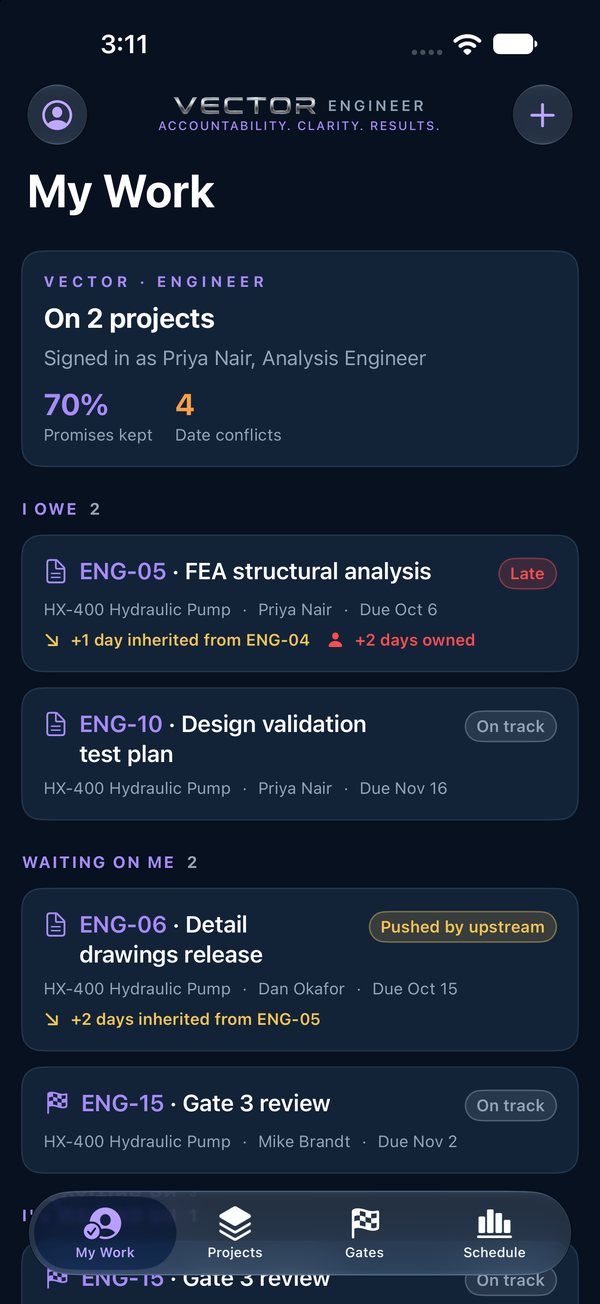
- "Your next move" tells each person the one thing that's waiting on them
- Ask for what you need from someone else, with the date you need it
- Promise reliability by person and team, from what actually happened
Trace
Late isn't the same as your fault
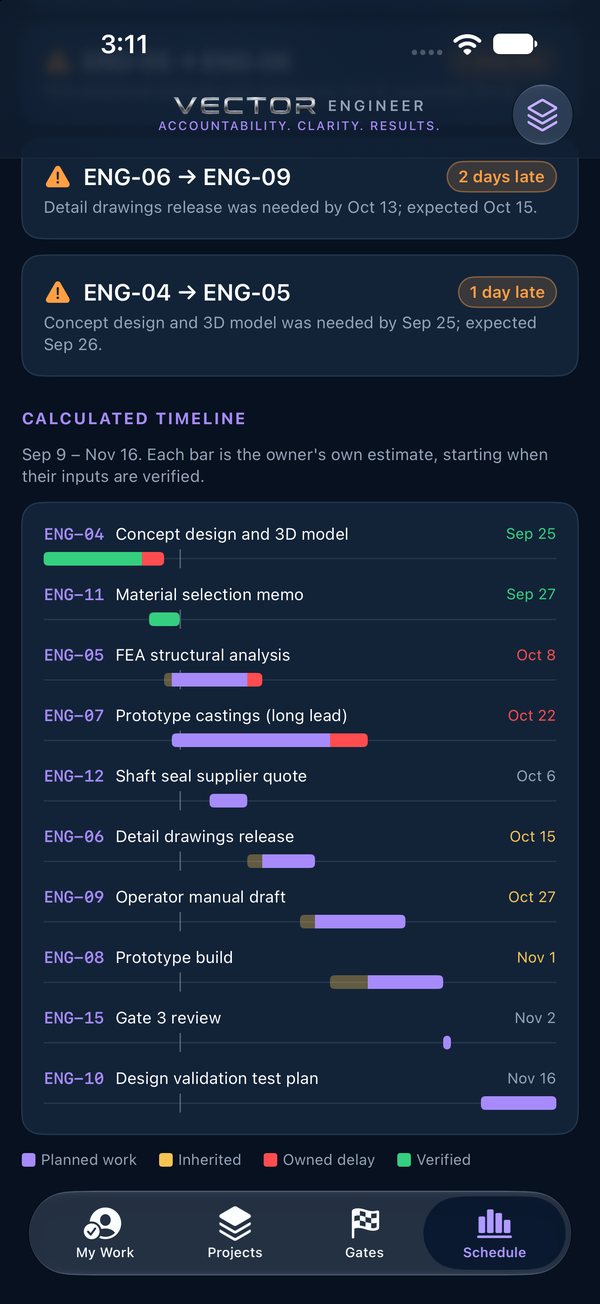
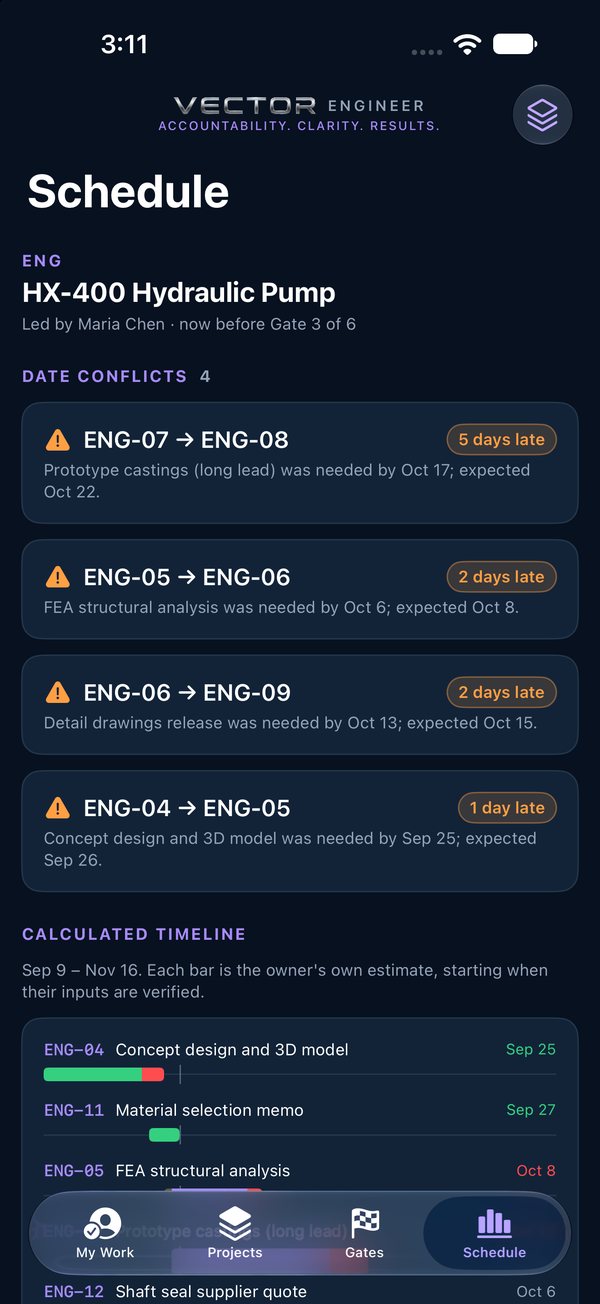
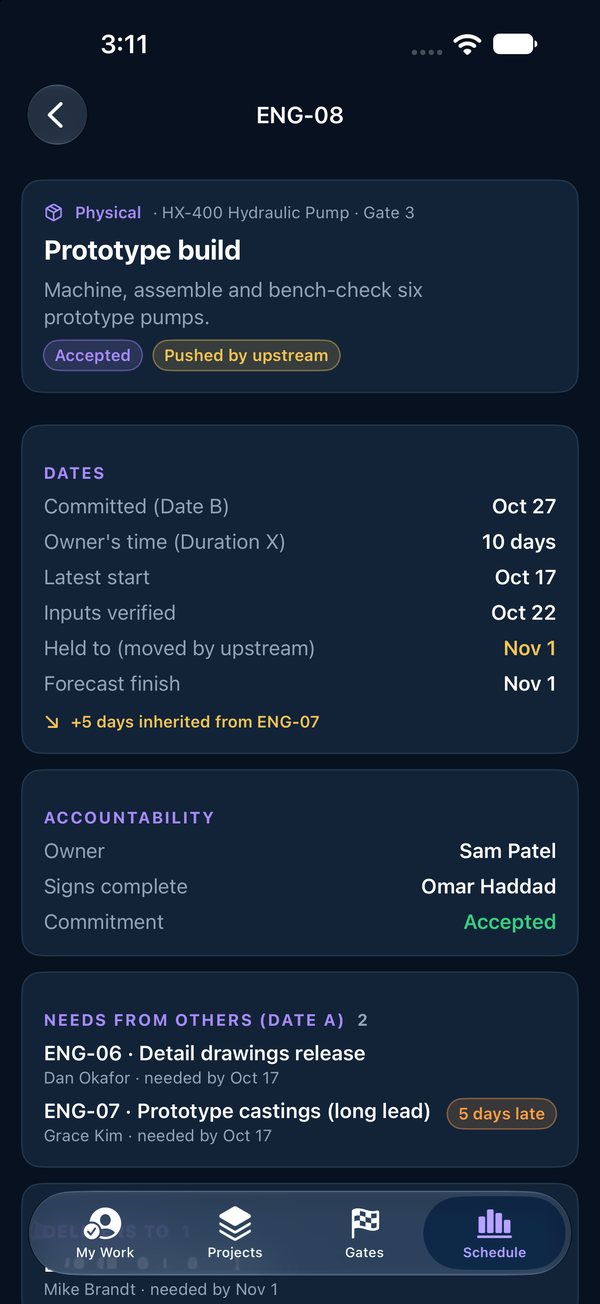
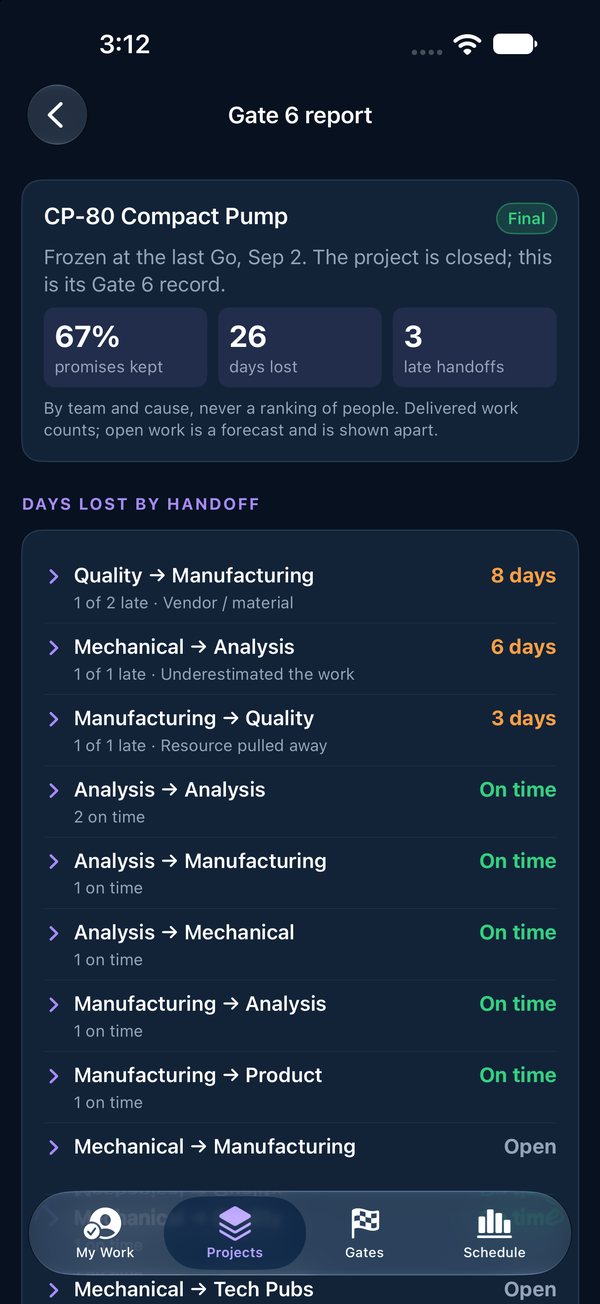
The schedule is calculated from what each piece of work is waiting on. When a vendor ships castings five days late, the build shows +5 days inherited from ENG-07, not five days of Sam being slow. Owned delay and inherited delay are counted separately, everywhere.
- Date conflicts show the moment a promise can't meet what depends on it
- Flag a slip early, with a reason, while it's still a warning
- Every day lost is tied to a handoff and a cause
Prove
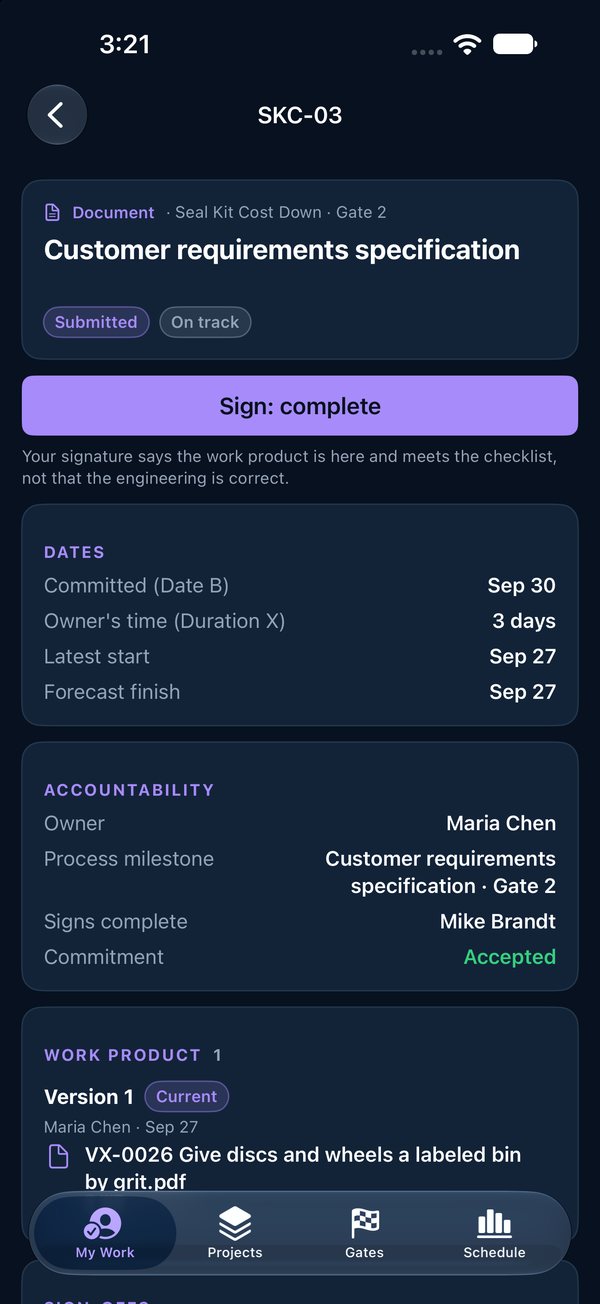
A signature covers one version. Exactly one.
Drawings, analyses, spreadsheets and photos attach as numbered versions. The checker signs the version they reviewed, and it locks. Add a new version and it needs a new signature. Nobody signs off their own work.
- A definition of done on every deliverable, ticked before it can be submitted
- Technical review and completion sign-offs, by different people
- Withdraw a wrong file and it stays on the record, struck through, with the reason
Review
Find it at the review. See it fixed before the gate.
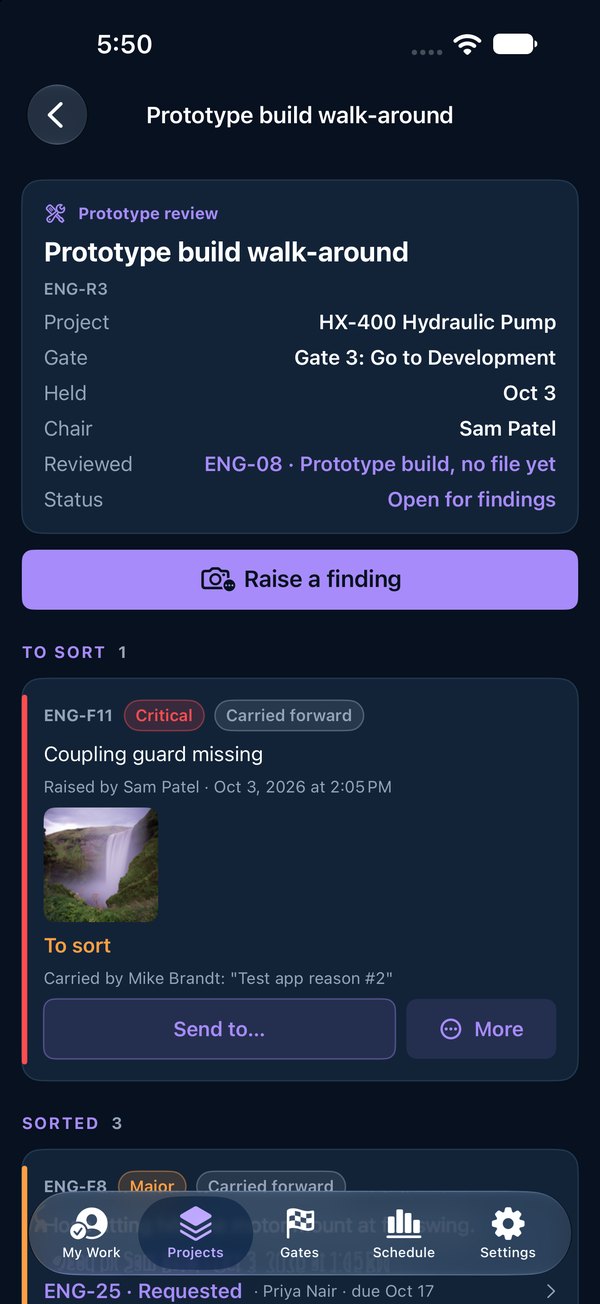
Design reviews, DFMEA and PFMEA reviews, prototype walk-arounds and drawing checks all end the same way: a list of problems, and a hope that someone owns each one. In Vector, anyone at the review raises a finding on the spot, with a photo and a severity. The chair sends each one to an owner as real work, with a date they accept. The person who saw the problem signs off the fix.
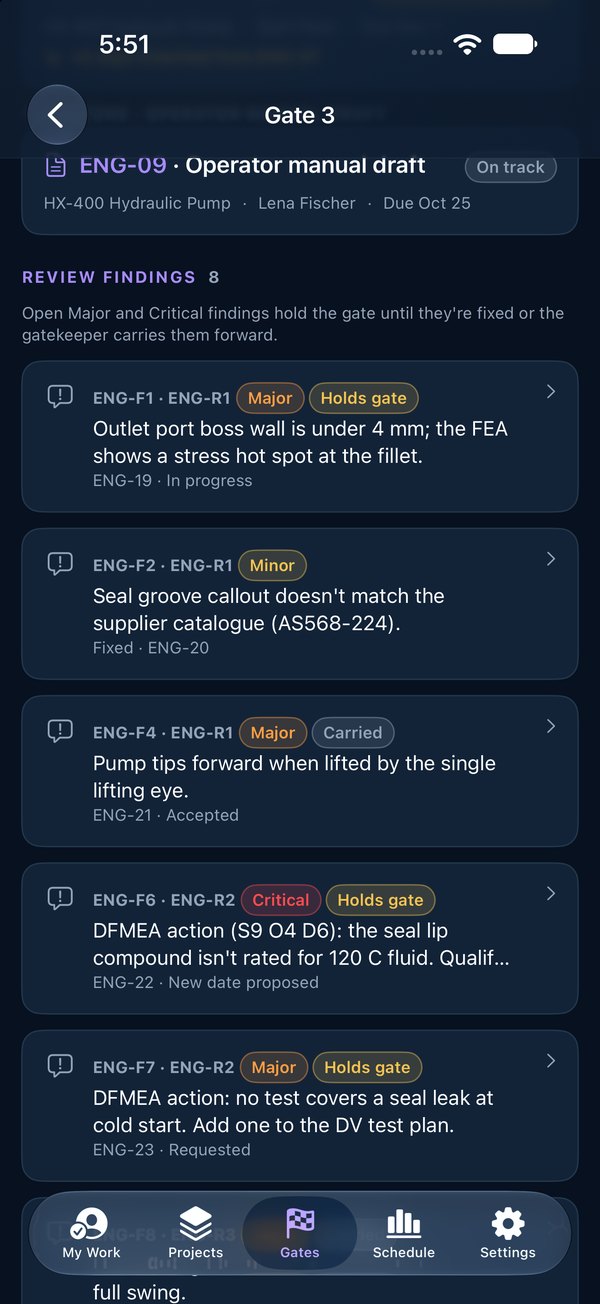
- Minor, Major or Critical. Open Major and Critical findings hold the gate
- The gatekeeper can carry one forward, with a note on the record
- FMEA stays in your own file; its actions come in as findings with owners
- Caught at a review against escaped after sign-off, in every Gate 6 report
Decide
Gate reviews that mean something
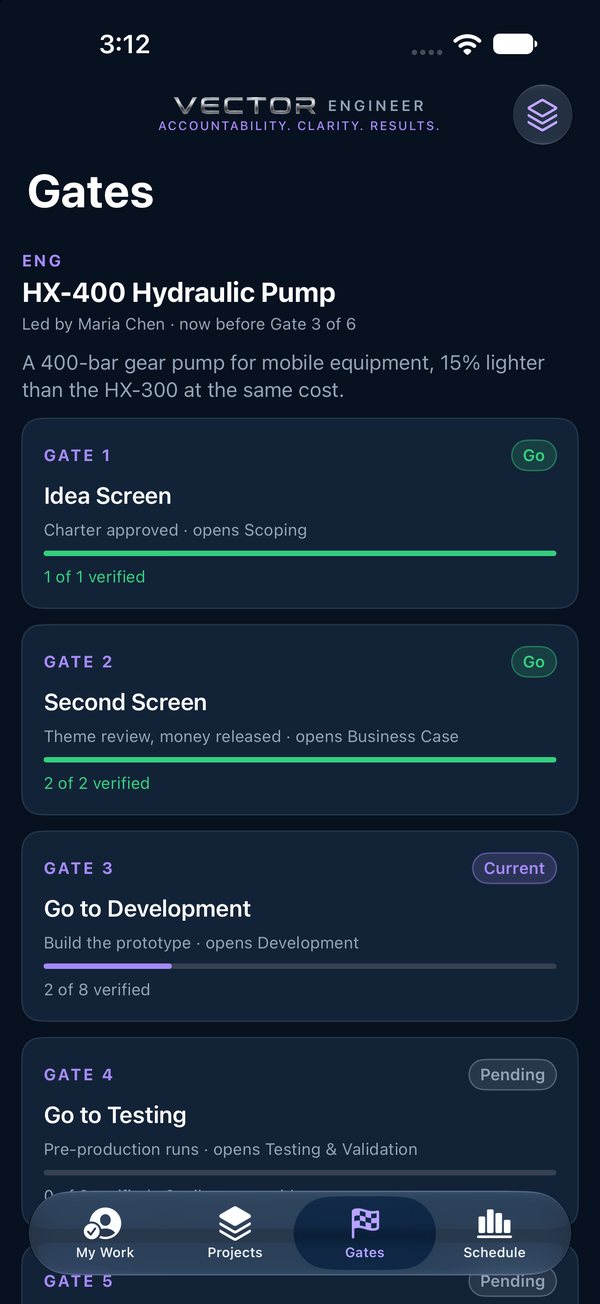
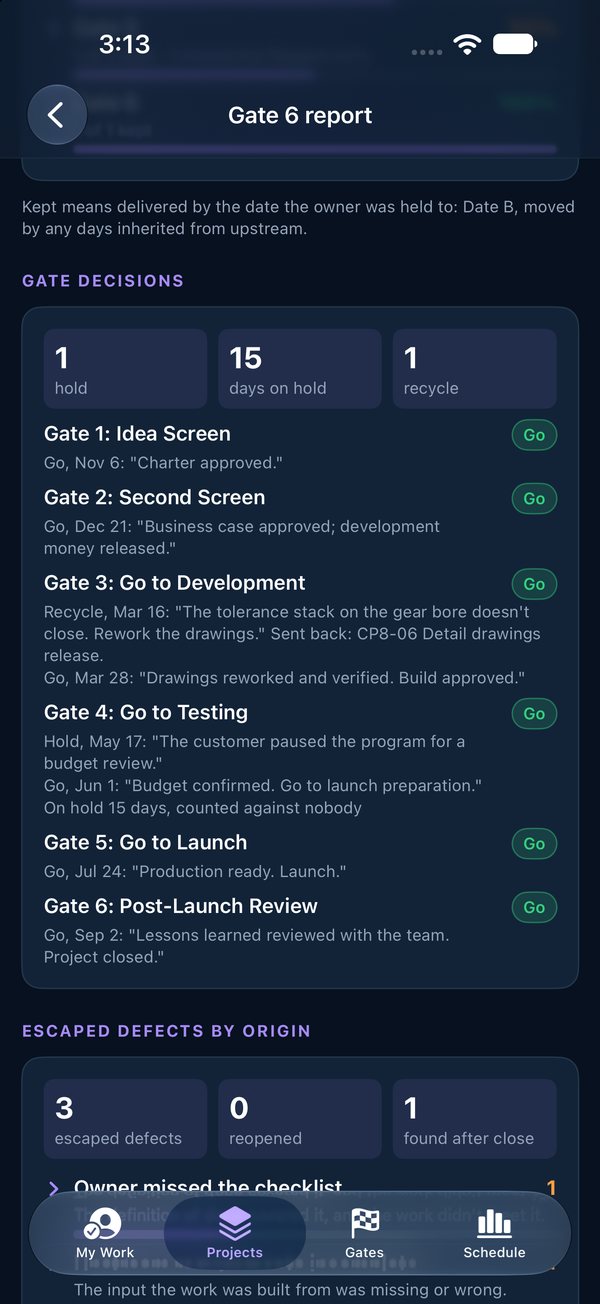
Go and Recycle wait until the gate's work is verified and no review finding holds it. Hold and Kill can be decided any time, because sometimes the right call is to stop. Every decision carries a note. Hold stops the clock, so the days on hold count against nobody. Recycle sends back exactly the work that needs redoing, with a new date the owners accept. Kill is final, and the team can still see why.
- Your gates and milestones: standard, new product, private label, or your own
- A gate or milestone that doesn't apply is approved by a manager, never skipped quietly
- "Gates for my review" on the gatekeeper's My Work
A slip, traced
Here's what one late casting looks like in Vector
The same slip, four handoffs downstream. Every person sees their own date move, and exactly where the days came from.
Prototype castings
The vendor slips. Grace flags it: "vendor material". Five days, owned at the source.
Prototype build
Sam's build moves five days. Vector shows it as inherited from the castings, not Sam's delay.
Validation test
Test planning sees the new date the day the slip is flagged, not the week of the test.
Gate 4 review
The gatekeeper sees five days lost at one handoff, one cause, one owner. Decisions get made on facts.
Learn
Lessons learned, without the meeting
The Gate 6 report builds itself from the record: days lost by handoff and cause, estimated against actual effort by team, promise reliability, every gate decision, and defects that escaped traced back to where they started.
- What the reviews caught, against what escaped after sign-off
- Log a defect against verified work, linked to the version that was signed
- The finder proposes where it started; someone else confirms
- A company view for leadership: every project, rolled up by team
Who it's for
Built for the people who ship the product
Project leads
A plan the team actually agreed to, a schedule that recalculates itself, and gate reviews backed by the record.
Engineers
Your next move, what's waiting on you, and credit for the delays that weren't yours.
Engineering managers
Validate your people's work, hand validation down, and approve what doesn't apply.
Leadership
Every project's gate decisions and lessons learned, rolled up by team, without asking for a status deck.
Everything a stage-gate needs, nothing it doesn't
Your gate processes
Several per company, each with its own gates and milestones.
Many projects
Everyone sees the projects they're on; managers see their people's.
Dependencies
Link what each deliverable needs, with the date it's needed by.
Versions that lock
Signed versions can't change. New versions need new signatures.
Full history
Every request, promise, slip, signature and decision, with who and when.
Defect traceback
Escaped defects linked to the signed work they came from.
Reviews and findings
Raised on the spot with photos, sent as work, signed off by the finder.
Suppliers by email
Ask anyone outside for a deliverable. No account, no seat.
Excel and print
Every report downloads as a workbook and prints cleanly.
Holds that stop the clock
Days on hold count against nobody, and every date moves with them.
One Vector account
The same sign-in as Vector Operations Pro.
Phone, tablet, desk
iPhone and iPad, and the full app on the web for the work done at a desk.
Questions
Do we have to use your gates?
No. Start from the common six-gate stage-gate, a new-product process or a private-label one, or set up your own gates and milestones. A project keeps the process it started with, and switching is approved and recorded.
Is this a replacement for our Gantt chart?
It's what a Gantt chart should be built from. The schedule is calculated from each owner's promise and what their work depends on, so it stays true without anyone redrawing bars.
Can we use it at our desks?
Yes. The full app runs on the web at vectorxpro.com/engineer/app, with drag-and-drop files, the wide schedule and the reports, as well as on iPhone and iPad. Setting up your gate processes, people and teams happens on the web.
Can suppliers and outside partners take part?
Yes. Ask a supplier or another department for a deliverable and they get a link by email. With no account and no seat, they accept the date or propose one, add their files and submit them for sign-off, on the same record. Whoever asked answers for the work inside your company.
Does it replace our FMEA software?
No. Keep the FMEA in the tool or spreadsheet you use now and attach it to the work it belongs to. At a DFMEA or PFMEA review, bring its recommended actions into Vector as findings, so each one gets an owner, a date and a sign-off, and the gate can't pass with a serious one still open.
Who can raise a finding at a review?
Anyone on the project's team, their managers, and anyone the chair adds to that review, such as a quality engineer or someone from the plant. A person from outside the team sees that review and nothing else of the project.
Who can see our projects?
People on a project see all of it, because handoffs cross teams. Managers see their people's projects, and leadership sees everything. See our privacy policy.
What does it cost?
One subscription per company, by how many people hold a Vector Engineer seat: from $349 a month for up to 10. Suppliers working from an emailed link are free, the first 30 days are free, and founding customers get 30% off for their first two years after the free trial. See the pricing.
Is there a manual?
Yes. The Owner's Manual (PDF) walks through setting up a company, running a project and reading the reports. The Help Center has every screen, step by step.
Bring your messiest project
Thirty minutes with your own gates and your own handoffs. We'll show you where the days are really going.
Book a demoSee the pricing · Read the Owner's Manual · See the other Vector apps